
Updated 2026 Edition
The Essential L-1 Handbook
Practical Guide to the L-1 Intracompany Visa for Entrepreneurs and Executives Expanding to the U.S. Market.
The Essential L-1 Handbook
Contents
- 01 · The L-1 at a Glance
Why the L-1 is one of the most efficient ways for an entrepreneur or executive to move into the United States. 1 - 02 · L-1A and L-1B
Understanding the two L-1 categories — executive/manager transfers and specialized-knowledge transfers. 3 - 03 · Benefits of the L-1
Why the L-1 is one of the strongest options for moving talent into the United States. 7 - 04 · Eligibility Requirements
What the employee and both the U.S. and foreign companies must each prove to qualify. 10 - 05 · New Office & Employee Structure
What a brand-new U.S. office must demonstrate, and the three-tier employee structure USCIS expects. 12 - 06 · Establishing U.S. Operations
How entrepreneurs and executives from any country use the L-1 to open or expand a U.S. presence. 15 - 07 · How to Apply
Two routes to receive an L-1: a USCIS petition with consular processing, or a change of status within the U.S. 17 - 08 · Critical Evidence
The critical documents that make or break an L-1 petition. 20 - 09 · Renewal Process
How long L-1 status lasts and how to renew or maintain it. 23 - 10 · Real-World Scenarios
How L-1 transfers play out across technology, expansion, and specialized roles. 25 - 11 · About AmLaw Group
A boutique U.S. immigration firm helping families and businesses build their future in the United States. 28

Chapter 01
The L-1 at a Glance
Why the L-1 is one of the most efficient ways for an entrepreneur or executive to move into the United States.
1
Entrepreneurs and executives can transfer into U.S. operations through the L-1 intracompany visa — a direct route for the leaders and specialists who already drive the business.
The L-1 moves executives, managers, and specialized-knowledge employees from a foreign office to a related U.S. operation. It serves growing companies and established businesses alike — including those opening a brand-new U.S. office for the first time. Because the move happens within one corporate family, there is no labor-market test and no new-employer requirement.
Two categories exist: L-1A for executives and managers (up to 7 years) and L-1B for specialized-knowledge workers (up to 5 years). It is dual-intent, so you can pursue a Green Card while in status — with no annual quota and spouse work rights.
What is the L-1 Visa?
The L-1 lets a qualified employee move from a foreign office to a related U.S. entity without labor-market testing. It requires a qualifying relationship — parent, subsidiary, branch, or affiliate. USCIS looks at whether one entity controls the other, not a strict 50% threshold, and both must actively conduct business.
No quota. Dual intent. Spouses can work.
The L-1 is not subject to any annual cap or lottery, recognizes dual intent so you can pursue a Green Card, and lets your spouse work in the U.S. without restriction — a combination few other work visas offer.

Chapter 02
L-1A and L-1B
Understanding the two L-1 categories — executive/manager transfers and specialized-knowledge transfers.
3
The L-1 has two categories that serve distinct roles. Which one fits determines your maximum stay, the evidence you must assemble, and — most importantly — the Green Card pathway available to you.
The Two Categories at a Glance
| Feature | L-1A | L-1B |
|---|---|---|
| Position | Directs the organization or a major component, with authority over staff and budgets | Advanced company knowledge that is rare in the industry |
| Prior employment | At least 1 year as an executive or manager within the last 3 years | At least 1 year in a specialized-knowledge role within the last 3 years |
| Initial period | Up to 3 years; 1 year for a new office | Up to 3 years; 1 year for a new office |
| Maximum stay | 7 years | 5 years |
| Green Card path | EB-1C; no labor certification | Usually PERM (EB-2/EB-3), unless NIW or EB-1A |
Both categories share the same foundation: at least one continuous qualifying year abroad with the related foreign entity within the three years preceding entry, and a qualifying corporate relationship between that entity and the U.S. employer. Initial admission runs up to 3 years (just 1 year for a brand-new U.S. office), after which extensions are granted in increments of up to 2 years.
L-1A — Executives & Managers
The L-1A is built for employees who direct the organization or a major division of it. Executives set goals and policies, exercise wide latitude in decision-making, and operate with minimal supervision. Managers manage the company or a major division of it, hold authority over staff and budgets, and supervise professional employees — rather than primarily performing the hands-on work themselves. The L-1A allows a maximum stay of seven years and is the category that most cleanly supports a Green Card.
The L-1A → EB-1C advantage
L-1A executives and managers map directly onto the EB-1C immigrant category, which requires no labor certification (PERM — Program Electronic Review Management) and no test of the U.S. labor market. For qualifying executives, this is often the single fastest employer-sponsored route to a Green Card.
L-1B — Specialized Knowledge
The L-1B covers employees with advanced knowledge of the company’s products, services, research, systems, or proprietary processes — expertise that is genuinely uncommon in the broader industry, not merely skilled or experienced.
L-1B applicants prove unique skills — not management
L-1B applicants prove genuinely unique skills, not managerial capacity — and that similarly skilled professionals aren’t readily available in the U.S. They typically pursue a Green Card via EB-2 or EB-3 PERM, unless they qualify for a PERM-bypassing category such as the EB-2 NIW or EB-1A.

Chapter 03
Benefits of the L-1
Why the L-1 is one of the strongest options for moving talent into the United States.
7
The L-1 offers several advantages over alternative work visas, particularly the capped and occupation-restricted H-1B.
No occupation restrictions
Covers executive, managerial, or specialized-knowledge roles in any industry — not a fixed profession list.
Dual intent
Pursue a Green Card while keeping L-1 status — file, adjust, and travel without complications.
Direct EB-1C pathway
L-1A executives often reach a Green Card via EB-1C in 1–2 years, no labor certification.
Spouse work authorization
L-2 spouses work in the U.S. without restriction — ideal for dual-career families.
Direct company transfer
Move within your own organization — no new employer or labor-market test required.
No annual lottery
No numerical cap. File whenever needed, unlike the capped H-1B lottery.
L-1 and H-1B Compared
| Feature | L-1 | H-1B |
|---|---|---|
| Eligible roles | Broad internal roles | Specialty occupation |
| Annual lottery | No | Usually yes |
| Dual intent | Yes | Yes |
| Spouse work | Yes, unrestricted | Limited (EAD) |
| Labor-market test | None | LCA required |
| Green Card path | Strong for L-1A (EB-1C) | Standard PERM |
L-1B Green Card route
L-1B holders don’t have a special Green Card category but can typically pursue standard PERM labor certification for EB-2 or EB-3. Dual-intent recognition makes starting that process simpler.

Chapter 04
Eligibility Requirements
What the employee and both the U.S. and foreign companies must each prove to qualify.
10
To qualify, both the employee and the two companies — U.S. and foreign — must satisfy eligibility requirements. The requirements differ depending on how long the U.S. company has been operating.
Company Requirements
The foreign company and the U.S. entity must maintain a qualifying relationship — one must be a parent, subsidiary, affiliate, or branch of the other. This typically means common ownership and control; USCIS does not impose a strict 50% threshold, and ownership may be more or less than 50% as long as control is established. Both entities must operate regularly and continuously. Simply maintaining an agent or office without active operations does not suffice.
Employee Requirements
You must have worked for the qualifying foreign company for at least one continuous year within the last three years before entering the U.S., in an executive, managerial, or specialized-knowledge capacity. The U.S. role must continue this high-level position.
Three parties must qualify.
Eligibility isn’t just about the person transferred — the employee, the U.S. company, and the foreign company must each independently meet the L-1 requirements.

Chapter 05
New Office & Employee Structure
What a brand-new U.S. office must demonstrate, and the three-tier employee structure USCIS expects.
12
Opening a brand-new U.S. office carries its own requirements — and building a credible employee structure is critical to every L-1 petition.
New Office Requirements
- Secured physical premises for the U.S. operation — a signed lease, not just an intention to rent.
- Financial ability to commence operations and sustain the business until it reaches profitability.
- A five-year business plan showing realistic growth, staffing, and revenue projections.
- Creation of at least eight jobs during the first year of operations.
U.S. Employee Structure
USCIS expects an established U.S. entity to support its executive with a genuine team. In practice, this means a minimum of eight or more U.S. employees arranged in a three-tier organizational structure. It is extremely important that mid-level managers have higher education, not necessarily from the United States, and supervise lower-level employees, so the executive truly directs the organization rather than performing day-to-day tasks.
Timing depends on the office type. For a new office, the business plan must show that this employee structure — including educated mid-level managers — will be created within the first year of operations. For an existing U.S. company, the structure must already be in place at the time the petition is filed.
Executive / L-1A Principal
Mid-Level Manager
Operations
- Employee
- Employee
- Employee
Mid-Level Manager
Sales & Marketing
- Employee
- Employee
- Employee
A clear three-tier structure: executive, mid-level managers, and the employees they supervise.
Build the structure first.
Creating the required employee structure and jobs is critical for every L-1 petition. It is important to keep in mind that USCIS looks not only at the number of employees, but also at their roles and education. For example, mid-level managers must have a higher degree. Without a credible team supporting the executive or manager, USCIS will question whether the role is genuinely managerial.

Chapter 06
Establishing U.S. Operations
How entrepreneurs and executives from any country use the L-1 to open or expand a U.S. presence.
15
The L-1 is built for ambitious businesses. Wherever your company is headquartered, the same framework moves your people into a related U.S. entity.
A Route for Companies Anywhere
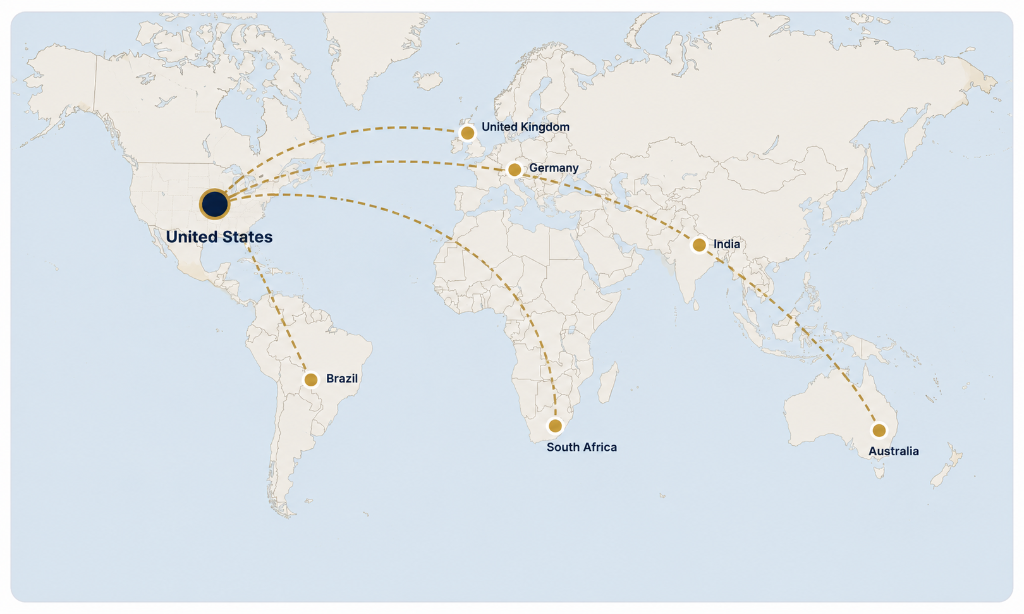
One framework moves talent into a related U.S. entity, from any country and in any industry.
What matters for the L-1 is the qualifying corporate relationship between the foreign entity and the U.S. operation, and the employee’s qualifying year of prior employment abroad. A software founder, a manufacturer, and a logistics group can all use the same category to move leadership into the United States.
Nationality does not decide eligibility.
Unlike the E-2 visa — which is only open to nationals of treaty countries — L-1 eligibility is not dependent on your nationality. The qualifying corporate relationship and the employee’s role are what matter, making the L-1 available to entrepreneurs and executives from virtually anywhere.

Chapter 07
How to Apply
Two routes to receive an L-1: a USCIS petition with consular processing, or a change of status within the U.S.
17
There are two common routes to receive an L-1. Which applies depends on where you and your family are when the petition is filed.
Route 1 — USCIS Petition + Consular Processing
Applicable to all nationalities. First, the U.S. company works with its attorney to prepare all needed documentation, including registration of the company and preparation of the business plan, if those are necessary (typically 2–4 months). The U.S. employer then files the petition with USCIS.
USCIS reviews the petition. Premium processing provides for a decision within 15 business days. Without premium processing, USCIS may take 4–6 months to review the case. After approval, the applicant applies for the L-1 interview at a U.S. consulate. Interview availability varies by location, but the process may take 1–3 months. Upon approval at the consulate, the applicant travels to the U.S. to be admitted in L-1 status.
The length of authorized stay granted on admission depends on the petition type: a brand-new U.S. office receives an initial period of 1 year, while a transfer to an existing U.S. company receives up to 3 years.
- Preparation of petition and supporting documents — 2–4 months.
- USCIS reviews the petition — 15 business days with premium processing or 4–6 months without it.
- Apply for the L-1 interview at a U.S. consulate — 1–3 months depending on location.
- Travel and receive L-1 status / I-94 — on entry.
After approval and entry, the employee receives an I-94 record reflecting L-1 status and authorized stay, accessible electronically through CBP. Citizens of Canada are visa-exempt and may present the approved petition directly at a U.S. port of entry.
Route 2 — Change of Status Within the U.S.
When the applicant and family are already lawfully inside the United States, the preparation and USCIS review steps are identical to the consular route. Upon approval, the principal applicant’s status changes to L-1 immediately. Dependents’ change of status, however, takes approximately 4–6 months to process.
Stay until the family is approved.
Because dependents’ change of status takes roughly 4–6 months after the principal is approved, the principal applicant should remain in the U.S. until the dependents receive their approvals — leaving early can disrupt their pending applications.

Chapter 08
Critical Evidence
The critical documents that make or break an L-1 petition.
20
The nuances of every L-1 petition vary based on the particular circumstances of the applicant and their work history. This section focuses on the more critical documents that are common to most petitions and play an important role in deciding the outcome.
U.S. Company Support Letter
- The planned activities of the U.S. operation.
- The job duties, salaries, and required education of the anticipated subordinates whom the applicant will manage in the United States.
- A clear explanation of why the applicant is necessary for the U.S. entity.
Foreign Company Support Letter
- A detailed description of the applicant’s role and job duties abroad.
- The names and job duties of the subordinates the applicant managed at the foreign company.
- Their education level, salary, work history, and the applicant’s role in managing them.
Specialized Knowledge Cases (L-1B)
For L-1B petitions, the decisive evidence is a detailed explanation of the applicant’s unique skills — what the knowledge is, how it was acquired, and why similarly skilled professionals are not readily available in the U.S.
Employment & New Office Evidence
- Employment evidence: payroll records, tax records, and proof of salary payments for the applicant for the past 12 months.
- New office cases: a five-year business plan and a U.S. lease agreement of no less than one year, for office space adequate for all current and future employees planned for the first year.
- Evidence of office operations: business licenses and photographs showing the actual office space, equipment, company signage or plaques, and the exterior of the office building.
The support letters are everything.
The support letters from the foreign and U.S. companies are the most critical documents in any L-1 petition. Invest the most care here — they tie the role, the relationship, and the business need together.

Chapter 09
Renewal Process
How long L-1 status lasts and how to renew or maintain it.
23
Initial L-1 admission lasts up to 3 years for transfers to existing U.S. companies; new-office transfers receive 1-year initial periods.
Renewal Process
When your initial period ends, your employer files Form I-129 with USCIS to renew L-1 status. Each renewal grants up to 2 additional years: L-1A holders to a 7-year total, L-1B holders to 5 years. After maxing out, you must spend at least one continuous year outside the U.S. before a new L-1 petition. Time in L-1B counts toward the maximum if you later switch to L-1A with the same U.S. entity — the clock does not reset.
Maintaining Status
Your approved petition lets you work only for the petitioning employer. Material changes — an office relocation or major shifts in job duties — may require an amended petition. The foreign company must continue operating at similar levels throughout the L-1 validity period; USCIS verifies the overseas entity stays functional and in a qualifying relationship during renewal reviews.
Key duration limits
- Existing office: up to 3 years initial · New office: 1 year initial
- Each renewal: up to 2 additional years
- L-1A maximum: 7 years · L-1B maximum: 5 years
- After maxing out: depart for 1 continuous year before a new petition

Chapter 10
Real-World Scenarios
How L-1 transfers play out across technology, expansion, and specialized roles.
25
These illustrative scenarios — based on the kinds of matters our attorneys handle — show how L-1 transfers enable career advancement and business growth across industries and regions.
Technology Sector Transfer
London, UK · L-1A Executive
Company Profile: London technology company promoting an engineering manager to director in San Francisco.
Challenge: Move a key manager to the U.S. quickly without a new employer or labor-market test.
L-1 Strategy: L-1A petition documenting managerial authority over multiple departments, filed with Premium Processing.
Outcome: Approved in under two weeks; EB-1C Green Card process began six months later.
Opening New U.S. Operations
Munich, DE · New Office
Company Profile: German manufacturing & logistics firm establishing a Los Angeles subsidiary.
Challenge: Send an operations director to launch a brand-new U.S. office with modest startup capital.
L-1 Strategy: New-office L-1A showing secured premises, realistic startup costs, and a service-focused business plan.
Outcome: 1-year approval; extended two more years after hiring staff and winning contracts.
Specialized Knowledge Transfer
Singapore · L-1B Specialized Knowledge
Company Profile: Singapore financial-services firm with proprietary trading algorithms built over ten years.
Challenge: Send a senior quant analyst to train the New York team on unique, non-public systems.
L-1 Strategy: L-1B emphasizing knowledge of proprietary algorithmic platforms not available in the broader industry.
Outcome: Approved after consular interview; three years of knowledge transfer while pursuing an EB-2 Green Card via PERM.
What these cases show
Across very different companies, countries, and roles, the same pattern holds: thorough documentation plus the right L-1 category produces fast, durable outcomes.
- Companies from any country can transfer key people into a related U.S. entity.
- L-1A transfers open a clean EB-1C path; L-1B supports a PERM-based Green Card.
- Even brand-new U.S. offices succeed when premises, capital, and a credible plan are in place.
Chapter 11
About AmLaw Group
A boutique U.S. immigration firm helping families and businesses build their future in the United States.
28
About AmLaw Group
AmLaw Group
U.S. Immigration & Global Mobility Counsel
You’ve built something worth expanding, and you want a U.S. presence without putting your business, your timeline, or your family in the wrong hands. That’s where we come in. We help entrepreneurs and executives establish and grow U.S. operations, secure the right L-1 strategy, and chart the Green Card pathway that follows — so the move advances your business and your family at the same time.

“Your ambition to build in America deserves a team that treats your goals — and your family’s future — as its own.”
Your Business Expansion
- We structure your U.S. entity and L-1 petition around your real growth plan.
- New-office launches and established-office transfers, handled end to end.
Your Immigration Success
- Strategy first — we position your case for approval, not just paperwork.
- We map the Green Card pathway that follows your transfer from day one.
Your Family’s Future
- Spouse work rights and children’s schooling planned alongside your case.
- We coordinate timing so the whole family arrives and settles smoothly.
A Team Beside You
- Boutique attention — direct access to the attorney handling your matter.
- Responsive, personal guidance at every stage of the process.
Schedule an L-1 Strategy Call
Ready to Plan Your Transition to the U.S.?
Schedule your strategy call. We’ll assess your eligibility, review your company structure, and build your path to U.S. residency.
Book your consultation
1920 E. Hallandale Beach Blvd. Suite 709, Hallandale Beach, FL 33009
Copyright © 2019-2026 AmLaw Group. All rights reserved. This handbook is for general informational purposes only and does not constitute legal advice. No attorney-client relationship is formed through use of this guide.